
American Eagle Gold Bullion Coins: Everything You Need to Know From 1986 to Today
The Origins of an American Icon
When Congress passed the Gold Bullion Coin Act of 1985, it set the stage for one of the most recognizable and widely traded gold coin programs in the world. Beginning in 1986, the United States Mint began striking American Eagle Gold Bullion Coins, offering American investors a federally guaranteed way to own gold for the first time since the Roosevelt-era restrictions had curtailed private gold ownership decades earlier. The timing was deliberate — demand for gold investment vehicles was strong, and the United States had a compelling design legacy to draw upon.
The obverse of the American Eagle gold coin pays direct homage to Augustus Saint-Gaudens, whose 1907 Liberty design for the double eagle is widely regarded as the finest coin ever produced by the United States Mint. Sculptor Miley Busiek adapted the striding Liberty figure — torch in one hand, olive branch in the other — for the modern series, while the reverse features a family of eagles designed by sculptor Sherl Joseph Winter, a patriotic composition that reinforces the coin’s national character. The result is a coin that carries genuine artistic heritage while functioning as a serious investment instrument. Collectors who appreciate that Saint-Gaudens legacy in its original form may also find interest in a 1916-S Saint-Gaudens Double Eagle, the very design that inspired the Eagle’s obverse.
Four Denominations, One Program
The American Eagle Gold Bullion program is structured around four distinct denominations, each corresponding to a specific gold content. The one-ounce coin carries a face value of $50 and contains one troy ounce of 22-karat gold — specifically, .9167 fine gold alloyed with silver and copper for added durability. This is the flagship of the series and the most actively traded denomination among investors and institutions alike.
The half-ounce coin bears a $25 face value and contains one-half troy ounce of gold. The quarter-ounce carries a $10 face value with one-quarter troy ounce, and the smallest denomination — the tenth-ounce — carries a $5 face value with one-tenth troy ounce of gold. All four denominations share the same obverse and reverse designs and are struck to the same 22-karat alloy standard. The fractional denominations allow collectors and investors with varying budgets to participate in the program, and they are frequently packaged together in four-coin sets that have become collectible in their own right.
Bullion, Burnished, and Proof: Understanding the Distinctions
One of the most important distinctions a buyer must understand is the difference between the three primary strike types within the American Eagle gold program. Standard bullion strikes are produced in large quantities for investment purposes and sold through a network of authorized purchasers, not directly to the public through the Mint. These coins carry no mintmark and are valued primarily by their gold content relative to spot price. Their condition can vary, and they are not intended as premium collectibles.
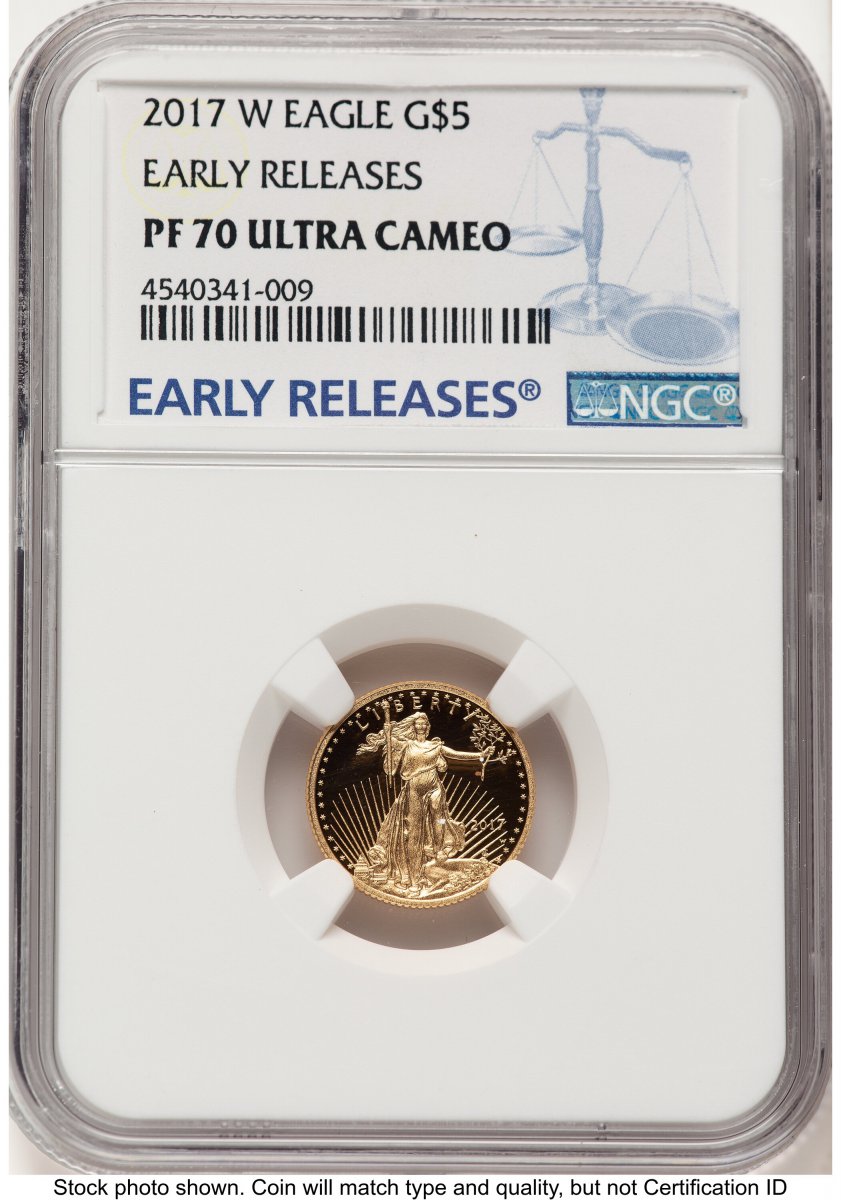
Proof American Eagles are an entirely different product. Struck at the West Point Mint and bearing the “W” mintmark, Proof coins are produced using specially prepared dies and polished planchets, resulting in the sharp cameo contrast between frosted design elements and mirror-like fields that defines the Proof finish. These coins are sold directly to collectors by the Mint in limited quantities and command meaningful premiums above melt value. Similarly, Burnished Uncirculated coins — also bearing the “W” mintmark — were introduced in 2006 as a middle category between standard bullion and full Proof quality. Struck on hand-loaded burnished blanks, they offer a distinctly satin finish that appeals to collectors seeking something beyond the standard strike without paying the full Proof premium. A prime example of the Proof format at the fractional level is the 2017-W Proof Gold Eagle 1/10 oz, which showcases the classic West Point Proof presentation in the tenth-ounce size.
Anniversary and Special Issues Worth Knowing
Several milestone years have produced American Eagle gold offerings that hold particular significance for date collectors and set builders. The 1995-W Proof Gold Eagle 1/10 oz, included only in the five-piece anniversary set that year, is among the most coveted issues in the entire series — one of the lowest-mintage pieces the program has produced. Collectors who want a complete Proof set from that year must acquire the tenth-ounce from this special packaging rather than from a standard four-coin Proof set.
The 20th anniversary in 2006 brought the introduction of the Burnished Uncirculated coins and a commemorative three-piece set that featured the one-ounce in Proof, Burnished Uncirculated, and Reverse Proof finishes — the Reverse Proof being especially notable for its frosted fields and brilliant devices, a visual inversion of the standard Proof. The 30th anniversary in 2016 produced another Reverse Proof one-ounce coin alongside a Burnished Uncirculated issue, both bearing the “W” mintmark and produced in limited quantities. These anniversary pieces tend to carry strong long-term collector interest precisely because their mintages are constrained and their production is non-repeating. The modern bullion era has also yielded broader commemorative programs worth exploring, including the 2017-W American Liberty High Relief Gold Coin, struck in celebration of the 225th anniversary of the United States Mint.
Buying, Storing, and Tracking Value
For investors focused primarily on gold content, standard bullion American Eagles trade at a modest premium over spot — typically ranging from a few percent for one-ounce coins to somewhat higher percentages for fractional denominations, where production costs per ounce are greater. Premiums fluctuate based on market demand, availability from authorized dealers, and broader economic conditions. Tracking the daily gold spot price is essential context for any purchase or sale decision. Buyers who want a comparable modern gold bullion option may also consider the 2022-W Proof Gold Buffalo 1 oz, the American Eagle’s 24-karat counterpart and a perennial favorite among serious gold collectors.
Proof and Burnished examples require a different analytical lens. Their value is driven by a combination of melt value, mintage figures, population reports from major grading services such as PCGS and NGC, and collector demand for specific date-and-finish combinations. High-grade certified examples of low-mintage issues — such as the 1999-W Proof or the 1995-W Proof tenth-ounce — routinely trade well above their intrinsic gold value, making them numismatic assets as much as bullion holdings.
Proper storage is equally important. Raw bullion examples are best kept in protective holders or tubes away from humidity and handling. Proof and Burnished coins should remain in their original Mint packaging whenever possible, as condition and originality of presentation factor into resale value. For high-value examples, professional grading and encapsulation by PCGS or NGC provides both authentication and standardized condition assessment that the secondary market recognizes and rewards.
Premier Rare Coins maintains an extensive inventory of American Eagle Gold Bullion coins across all denominations, dates, and strike types — from standard bullion examples to low-mintage Proof and anniversary issues. Browse the current selection to find the right coin for your collection or portfolio, and contact our team with any questions about pricing, grading, or availability.