
The 1861-O Half Dollar: The Civil War Coin Struck Under Three Governments
“`html
A Mint Changes Hands in the Shadow of Secession
Few coins in American numismatic history carry the historical weight of the 1861-O Liberty Seated Half Dollar. Struck at the New Orleans Mint during one of the most turbulent years in the nation’s history, this single date encompasses the governmental chaos of secession and the opening salvos of the Civil War — all compressed into coins that are, to the untrained eye, virtually indistinguishable from one another.
When Louisiana formally seceded from the United States on January 26, 1861, the New Orleans Mint did not immediately cease operations. Instead, it continued striking coins under the authority of the State of Louisiana for a brief period before the state transferred control of the facility to the newly formed Confederate States of America in late April of that year. By the time the mint suspended coinage operations in the spring of 1861, the half dollar obverse dies had passed through three distinct sovereignties: the United States federal government, the independent State of Louisiana, and the Confederate States of America. All three struck half dollars bearing the same date and the same basic design, using the same equipment, and drawing from the same silver bullion reserves.
The Attribution Problem: Three Governments, One Coin
The numismatic consequence of this extraordinary sequence of events is both fascinating and frustrating. The overwhelming majority of 1861-O half dollars — with a combined mintage estimated at roughly 2.5 million pieces across all three governmental periods — cannot be definitively attributed to any one of those three administrations. The U.S. Mint had already shipped obverse and reverse dies to New Orleans before secession, and Louisiana and later Confederate authorities simply continued using those same dies. Without distinct die characteristics to differentiate most strikes, the coins look identical.
There is, however, one important exception. Researchers and numismatists, most notably through the work catalogued by the Confederacy’s own coinage records, have identified specific die cracks and die state progressions that can, in theory, place a small number of coins within a particular governmental period. Advanced die variety research using the Wiley-Bugert reference work on Liberty Seated half dollars has helped narrow attribution in select cases. But for the typical collector, an 1861-O half dollar in hand represents something genuinely ambiguous: a coin that may have been struck to fund Federal operations, Louisiana’s brief independent treasury, or the nascent Confederate war effort. That ambiguity is not a flaw — it is the coin’s most compelling historical characteristic.
The Four Original Confederate Half Dollars
While the circulating coinage of 1861-O remains largely unattributable, the Confederate States did make one unmistakable numismatic statement. In April 1861, Confederate authorities commissioned a unique reverse die, designed by a New Orleans dentist and amateur engraver named Dr. E. Ames, depicting a Confederate shield, a liberty cap, stars, and a agricultural wreath — imagery that would never appear on U.S. coinage. Using this Confederate reverse die paired with a standard U.S. obverse die, mint workers struck exactly four half dollars. These four coins are among the most historically significant pieces in all of American numismatics.
The coins vanished into private hands almost immediately. It was not until 1879 that they resurfaced in a meaningful way, when Confederate naval officer Captain John Haseltine facilitated their public rediscovery. At that point, coin dealer J.W. Scott acquired one of the original four pieces and, recognizing both the historical importance and the commercial potential of the discovery, embarked on a project to create restrikes that could be made available to collectors. Those interested in proof-quality survivors from this era of American coinage may find the 1871 Proof Seated Half Dollar a compelling companion piece, representing the same Liberty Seated series struck just a decade later in the war’s aftermath.
The Scott Restrikes of 1879: What They Are and How to Identify Them
Scott’s approach was methodical and, by the standards of his era, reasonably transparent. He located the original Confederate reverse die, which had survived intact, and used it to produce restrikes by applying the Confederate reverse to genuine Liberty Seated half dollars that had been planed down on the reverse side to remove the original U.S. design. These restrikes, produced in a limited quantity of 500 pieces, are themselves collectible numismatic artifacts — not originals, but historically connected objects that allow collectors to study the Confederate die design without access to one of the four impossible-to-acquire originals.
Distinguishing a Scott restrike from an original is straightforward for an experienced numismatist. The planing process leaves the obverse surface slightly concave or showing tool marks, and the edge of the coin often displays evidence of the removal of the original U.S. reverse. The Confederate reverse itself, when examined under magnification, shows die characteristics consistent with its 1861 manufacture, though strike quality on the restrikes can vary. Scott also produced a small number of restrikes on white metal (a tin alloy) and on paper, creating a documented series that has been well catalogued in the numismatic literature.
A Tangible Artifact of American Political Upheaval
What elevates the 1861-O half dollar beyond mere historical curiosity is its accessibility. Unlike many Civil War relics locked behind museum glass, a genuine 1861-O Liberty Seated Half Dollar in circulated condition remains acquirable by serious collectors at prices that reflect its significance without being prohibitive. Holding one means holding a coin that circulated in a country that was actively fracturing — a piece of silver that may have passed through hands on either side of a war that would define the next century of American history.
For investors and advanced collectors alike, the 1861-O half dollar occupies a rare position in the American series: a coin whose historical context is not merely backdrop but is inseparable from the object itself. The die variety specialist, the Civil War historian, the Liberty Seated devotee, and the student of American monetary history all find legitimate reason to pursue it. Those drawn to earlier chapters of American silver coinage often find that the Capped Bust Half Dollar series offers a natural complement — coins struck in the decades immediately preceding the Liberty Seated design, when the half dollar was already the workhorse of American commerce. Collectors who appreciate the half dollar’s long arc through American history sometimes extend their focus into the twentieth century as well; the 1917 Walking Liberty Half Dollar and the 1954-S Franklin Half Dollar represent the design succession that carried the denomination forward well past the Civil War era. That convergence of interest across collecting disciplines is precisely what sustains long-term numismatic value and enduring fascination.
Premier Rare Coins offers a carefully curated selection of Liberty Seated Half Dollars, Civil War-era coinage, and historically significant U.S. type coins. Browse the current inventory to find certified examples, die variety attributions, and pieces suited for both the advanced collection and the long-term investment portfolio.
Shop Related Coins
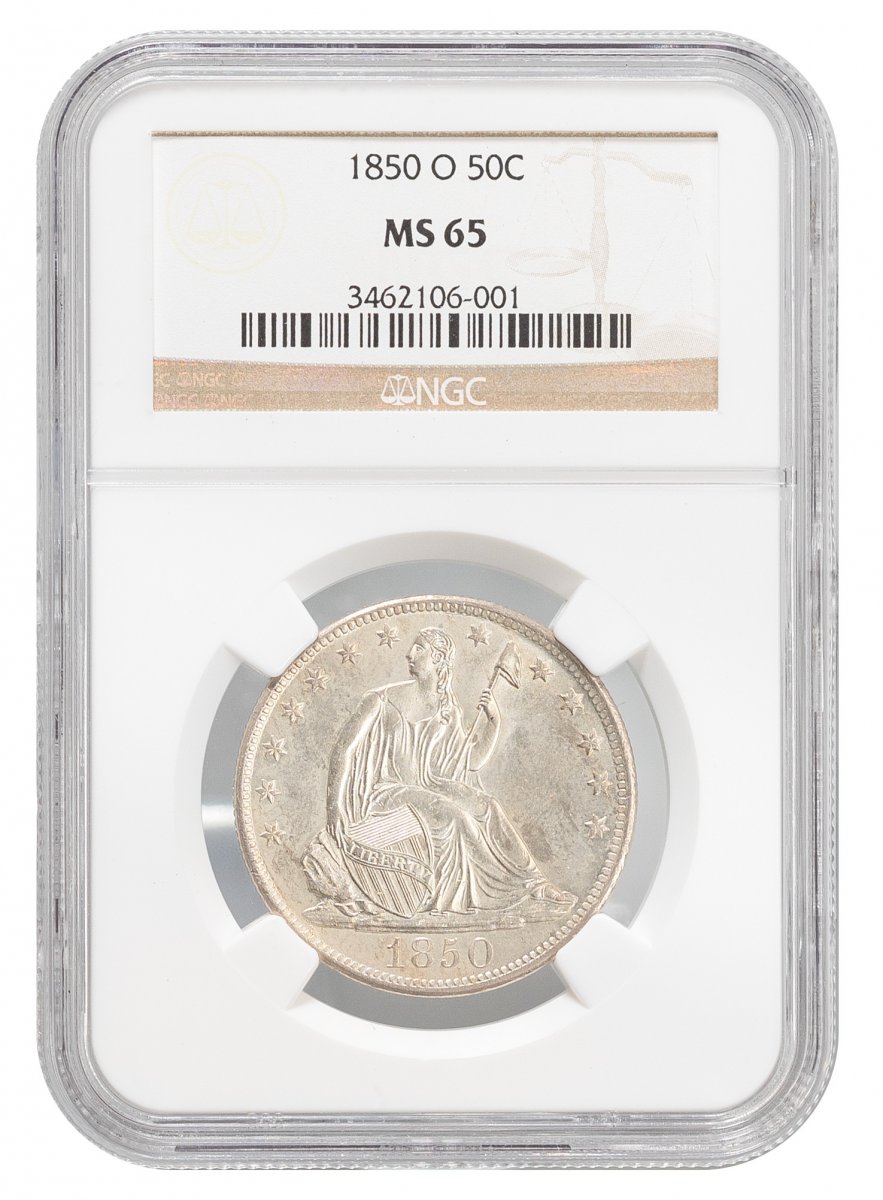
- 1850-O Liberty Seated Half Dollar — Type 2 No Motto — $10,450.00
- 1871 Proof Seated Half Dollar (NGC Plus) — $4,950.00
- 1835 Capped Bust Half Dollar — Type 1 Lettered Edge — $479.60
“`